Ebook Free Henri Cartier-Bresson: The Mind's Eye: Writings on Photography and Photographers, by Henri Cartier-Bresson
This Henri Cartier-Bresson: The Mind's Eye: Writings On Photography And Photographers, By Henri Cartier-Bresson belongs to the soft file book that we provide in this on-line website. You may find this kind of books and other collective books in this website actually. By clicking the link that we offer, you can go to the book site and enjoy it. Saving the soft file of this book becomes what you can overcome to read it everywhere. This way can evoke the break boredom that you can feel. It will also be a good way to save the file in the gadget or tablet, so you can read it any time.
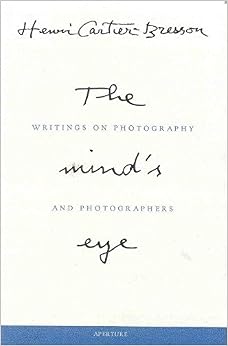
Henri Cartier-Bresson: The Mind's Eye: Writings on Photography and Photographers, by Henri Cartier-Bresson

Ebook Free Henri Cartier-Bresson: The Mind's Eye: Writings on Photography and Photographers, by Henri Cartier-Bresson
Don't make you really feel hard when looking for book that you will review to spare your time. Publication is always popular in every single time, every period, and also every age. All individuals will require book as reference to do something. When you have no ideas concerning what to do in this free time, get Henri Cartier-Bresson: The Mind's Eye: Writings On Photography And Photographers, By Henri Cartier-Bresson as one of the reference books that we supply! Offering unique books are so pleasurable for us. It is so simple to give generosity for everyone.
Guides that exist come from many libraries in the world. It implies that you will discover the hundreds publications from lots of writers as well as authors from the world. We realize that such individuals will require the book from various other country. If they must spend much cash to order and wait on many times, you could obtain various means here. Here, you could quickly obtain the easiest means to attach to the book as Henri Cartier-Bresson: The Mind's Eye: Writings On Photography And Photographers, By Henri Cartier-Bresson straight.
You may not expose that this publication will provide you whatever, yet it will offer you something that could make your life better. When other people still feels confused in choosing the book, it is various with just what you have actually gotten to. By downloading and install the soft data in this site, you could enhance guide as yours immediately. This is not type of magic style because of the existence of this site will certainly give you fast means to get guide.
You could alter your mind to be much better after obtaining the resources from some data. However when you have the resources from this book, you can take how different this publication view from others. Yeah, this is exactly what makes you feel completed to get rid of the function of the resources. Henri Cartier-Bresson: The Mind's Eye: Writings On Photography And Photographers, By Henri Cartier-Bresson turns into one referral that delivers the existence of new information as well as concepts. Currently, your time is for getting the book quicker. This is it the book that you need currently!
From Library Journal
Supremely accomplished and influential French photographer Cartier-Bresson guided the evolution of the photographic medium while creating an enormous body of work. His photographs of people, famous and obscure, always contain a strong psychological component deriving from formally perfect compositions and a temporal ambivalence that characterizes only the most powerful static images. This slight book contains short essays by Cartier-Bresson along with some less interesting aesthetic epigrams and tributes to fellow artists. This is the first published collection of his writings, though large chunks are taken from books he published in the 1950s and 1960s. And while there's not a great deal of his writings to be collected, what's here is pithy and laconic without being sententious. His artistic philosophy is well captured by his landmark 1952 essay "The Decisive Moment," contained here, probably the most poetically instructive evocation of the field photographer's art yet written. This is a useful and important title from one of the defining sets of eyes in the cumulative visual record of the 20th century. Recommended for academic and large public libraries.DDouglas F. Smith, Oakland P.L., CA Copyright 2000 Reed Business Information, Inc.
Read more
About the Author
Henri Cartier-Bresson was born in France in 1908. He studied painting and then began to photograph in the early 1930s. After escaping from prison camp in 1943, he made portraits of artists, covered the liberation of Paris and filmed a documentary on the return of war prisoners. In 1947, the year he had his first show at MoMA, he also founded Magnum Photos with Robert Capa, George Rodger and David Seymour. Not long after, he began in earnest the life of a traveling photographer, working in India, Burma, Pakistan, Indonesia, China, Japan, Mexico and Cuba. His first, defining book "The Decisive Moment" was published by Teriade in 1952. By the late 60s, he had almost ceased making reportage to re-embrace his first passion, drawing. Cartier-Bresson created his Foundation in Paris in 2003, and passed away in 2004.
Read more
Product details
Hardcover: 112 pages
Publisher: Aperture; 1st edition (June 15, 2005)
Language: English
ISBN-10: 9780893818753
ISBN-13: 978-0893818753
ASIN: 0893818755
Product Dimensions:
5.8 x 0.7 x 8.6 inches
Shipping Weight: 12 ounces (View shipping rates and policies)
Average Customer Review:
4.2 out of 5 stars
48 customer reviews
Amazon Best Sellers Rank:
#260,430 in Books (See Top 100 in Books)
I think it would have been a tall order for Henri to write down the information you would need to reach his level of photography. There are some exceptional documentaries on YouTube for free that you could take advantage of by watching to get some insight from him in his own spoken words and examples. This short read is his collection of writings that brings to a point photography of the day as it was for him. When he mocks the idea of the golden rule being etched onto a lens I sort of grin at the thought of grid lines appearing in modern DSLR cameras to guide in the use of rule of thirds. All this being said - in written words Henri conveys what he's thinking in some of the more general senses of his time with photography where the camera is his sketchbook and where you can try to find another 1000 words in the photos themselves ;) Color photography has come a long long way in the digital world so at a first read you might wonder why he avoided the use of it and made a point to write about it. Therefore, you have to read his writings with the respect he is due for his total mastery of photography. Make no mistake - he was a master. He didn't take the time back then to write about the formula it takes for him and how you can use this formula to get the same results with any camera. He gives you something more intimate in fact - his raw emotions of the world he lived in and how the camera reached out into the world as an extension of himself. Each person has his or her own art inside them and if you understand and appreciate the very fundamentals of photography then you have taken one more step in trying to reach your goals of an artist perhaps. If you read this book with these things in mind you will take something away from it :)
Yes, this is a small book, and, possibly too much of it is taken up in verbal bouquets tossed to old friends, tourist information about side-trips to various countries, and practical advice to would-be photojournalists.But those asides aren't the guts of this wonderful book. The important message from this man, who without question was the most influential photographer of the twentieth century, is that if you want to make good photographs you need to look, and you need to internalize a kind of respect for subject, context and geometry that allows you to SEE when you look, without resorting to arbitrary crutches like the "rule of thirds."Probably the most important words in the book are these: "To take photographs means to recognize -- simultaneously and within a fraction of a second -- both the fact itself and the rigorous organization of visually perceived forms that give it meaning."That's what the book is really about. Anyone who hopes to become a competent photographer needs to internalize that message.
Henri Cartier-Bresson, one of the founder of Magnum Photos rarely write, he rather shoot or sketch. That makes this book quite rare and significant. It compile Bresson writing in one book. Bresson discussed about his thought about photography especially photojournalism.By reading this book, you get insight about what inside Bresson's mind on photography, philosophy and what he thinks about other artists. Part two of the book discuss about Bresson's travel to China, Cuba etc. It provides interesting insight on his journey.However, this book is not technical how-to book, if you are looking for book that teach you how to take photo like Bresson, then you are looking for a wrong book. However, I think that the map/rules for Bresson's style can't be explained because it is basically no rules or map. But, you can get some valuable insights from this book and perhaps get a feel what Bresson is about.Here are some interesting paragraphs that I quote right from the book:"Subject does not consist of a collection of facts, for facts in themselves offer little interest. Through facts, however, we can reach an understanding of the laws that govern them, and be better able to select the essential ones which communicate reality.""The camera is for us a tool, not a pretty mechanical toy. In the precise functioning of the mechanical object perhaps there is an unconscious compensation for the anxietes and uncertainties of daily endevor. In any case, people think far too much about technique and not enough about seeing.""Complicated equipment and light reflectors and various other items of hardware are enough, to my mind, to prevent the birdie from coming out."
Keep reading and re-reading this little book for the gems it has within! Anybody interested in either Henri Cartier-Bresson the photographer and/or the person, as well those looking to find insight and enlightenment into the "decisive moment" and what it really means to capture moments of our lives (and those of others') ought to read this and hopefully obtain and retain some of the ideas presented in this compilations of things and topics related to HCB and photographic processes.
Very little if any technical guidance, but great insight into the philosophical approach of Bresson's work. A quick read that can be returned to as needed for inspiration.
It is a book of Cartier-Bressons' philosophy toward photography and art in general. I expected to read detailed approaches to photography that would make me a better photographer. I decided to read it again (its only a 100 pages long) and found that I appreciated it better the second time, and just let my 'artistic mind' wander with the author.
It's okay. A little disappointing. A fine, quick read, but not one to add to the collection. You're better off going to the rare book room in your public library and reading The Decisive Moment, or put the money for the book towards the re-release of the aforementioned book.
Simple, beautiful thoughts on creating the image in mind. Cartier-Bresson also shares insights on his travels and cultures he had experienced.
Henri Cartier-Bresson: The Mind's Eye: Writings on Photography and Photographers, by Henri Cartier-Bresson PDF
Henri Cartier-Bresson: The Mind's Eye: Writings on Photography and Photographers, by Henri Cartier-Bresson EPub
Henri Cartier-Bresson: The Mind's Eye: Writings on Photography and Photographers, by Henri Cartier-Bresson Doc
Henri Cartier-Bresson: The Mind's Eye: Writings on Photography and Photographers, by Henri Cartier-Bresson iBooks
Henri Cartier-Bresson: The Mind's Eye: Writings on Photography and Photographers, by Henri Cartier-Bresson rtf
Henri Cartier-Bresson: The Mind's Eye: Writings on Photography and Photographers, by Henri Cartier-Bresson Mobipocket
Henri Cartier-Bresson: The Mind's Eye: Writings on Photography and Photographers, by Henri Cartier-Bresson Kindle
Leave a Reply